Brick Chimney Repair in Lexington, KY
Replaced One Unit or One Course at a Time
Limestone Chimney Co covers brick chimney repair in Lexington, KY: the bricks themselves, not the mortar between them, whether spalled, cracked, loose or missing. Each can usually be fixed a brick at a time while the chimney still stands straight.
Telling a brick problem from a mortar problem
Chimney brick repair and joint repair get lumped together, but they are different jobs. Mortar is the sacrificial part of a wall, meant to wear first and be renewed; when the joints go sandy the answer is repointing the mortar joints, not new brick. A brick is meant to outlast the house, and once its face has blown off or a crack has run through it, fresh mortar around it changes nothing. A quick test from the ground: damage that follows the grid of joints is a mortar job, and damage sitting inside single bricks is a brick job. Older stacks often need both, priced in one scope.
Why so many Lexington chimneys are at the brick-replacement age
Lexington has 146,716 housing units. The median one was built in 1979, and about 68% went up before 1980, so a large share of the city's chimneys are original masonry with forty-five winters or more behind them. Freeze-thaw is what wears them down: water soaks in, freezes, thaws and freezes again, and each cycle does a little damage nobody sees until a brick gives.
Spalled brick: the face pops off and the brick keeps shedding
A fired brick has a hard outer skin over a more porous body. Water that reaches the body, through a hairline crack, a failed joint or from above, freezes and expands, and the skin gives way in flakes or one sheet. That is spalling, and it does not stop by itself. It shows first in the top courses under a cracked crown, on the side of the stack that faces the weather, and just above the roof where runoff splashes back. When it clusters near the top, a crown that has stopped shedding water is usually the source, and new brick under it only sets up the next ones.
Paint and film-forming sealers, the usual home remedy, make it worse. Brick has to let water out as well as in; a coating traps it behind the skin, and the freeze pushes the skin off from inside, coating and all.
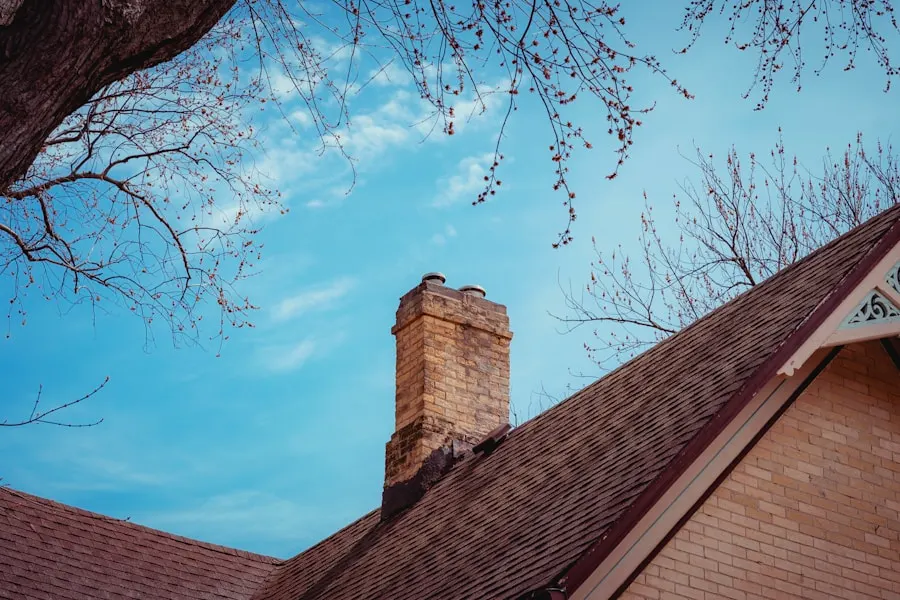
A crack through the brick rather than along the joint
A crack across the middle of a brick is a different sign from one that follows the mortar. A single cracked unit is often a brick laid in mortar harder than itself: when the wall moves with the seasons, the hard joint will not give, so the brick does. What matters is the pattern. Cracks that line up through several bricks, step diagonally down the stack or open wider over a season mean the stack itself is moving.
Loose, rocking or missing bricks at the top of the stack
The top few courses take the worst weather on the house, so that is where bricks work loose first. The mortar beneath them wears to sand, they rock in their beds, and in time one lands on the roof or in the gutter. The gap lets water straight into the core of the stack, so a missing brick is never only cosmetic, and a loose one should be reset or replaced before winter. If several across the top are loose, those courses usually come off and are relaid, the smallest kind of partial rebuild.
How a single brick or a short run of a course is replaced
Chimney brick replacement is done from the outside, one unit at a time. The mortar around the damaged brick is cut out and the brick is broken out without disturbing its neighbors. The new brick should be bedded in mortar matched to the wall, its joints tooled to the profile around it. A failed run in one course is replaced in short lengths, so the bricks above stay supported while the new ones set. Whatever let the water in belongs on the same visit, and the work is booked between March and November, while new mortar can cure in warm weather.
Matching old brick: size and color first, then hardness
A replacement brick has to match in three ways. Size: brick dimensions have shifted over the decades, and a unit a fraction off leaves joints that never line up. Color and surface: the right red with the wrong texture still reads as a patch from the street. And hardness, which matters most and shows least. A brick much harder than the old ones beside it will not take up water as they do, so the water moves into its neighbors and they spall next; a much softer one wears away ahead of the wall. Salvaged brick of the same age is often the closest match. Ask to see the replacement held against the old brick before it goes in.
Where brick repair stops and a partial rebuild starts
Brick repair holds as long as the stack has not moved. A straight chimney with a scatter of spalled, cracked or loose units is a replacement job. A lean, cracks stepping through the courses, or bricks that shift under a hand across a wide area mean the stack is moving, and new units would only be set into a wall that is still going. Damage across whole courses on more than one face points the same way. Then the stack is taken down to sound brick and relaid, and rebuilds here, partial or full, run $4,000 to $15,000; what sets a rebuild's price inside that range has a guide of its own. A rebuild is also the moment to read the flue, since the state's residential code requires a masonry chimney to be lined to suit the appliance venting into it.
Why no price per brick is printed here
No honest per-brick figure can be printed before someone has seen the stack, because the number is a count: how many bricks, on how many faces, how high, how hard to match, and what else on the chimney is due. The quote covers it, and the written scope should list it brick by brick. If the joints need work too, repointing runs $500 to $2,500 here, on the same scope from the same roof visit. The cost of each repair, read from what you can see, has its own page, and chimney repair across Lexington, crown to flashing, sits with the full price table.
What owners ask about chimney brick
Can a few bricks on a chimney be replaced without rebuilding it?
Will replacement brick match my old chimney?
What does a cracked brick on a chimney mean?
Point at the bricks, and get them counted.
Call (859) 493-8726, Mon–Fri 8:00am–5:30pm, or ask for a brick repair visit, with a photo from each side and a note of where the damage sits. The request goes to one independent Lexington-area chimney and masonry company, which prices the work and does it.