Chimney Repair & Masonry in Lexington
Chimney repair in Lexington, KY covers the mortar joints, the crown, the flashing and, once a stack has moved, the brick itself. A chimney is a column of brick that lives outdoors in Kentucky weather while everything around it hides under a roof. Its mortar, crown, and flashing are meant to be renewed — and renewing them on time is the whole art. Here's what each repair involves and what it honestly costs.
What chimney repairs cost here
Ranges below reflect the Lexington market — or work from the other direction with our symptom-by-symptom chimney repair cost guide. Ask for a written scope with a firm figure before a trowel comes out; where a cheaper fix will genuinely hold, the scope should say so.
| Repair | Typical range | What drives the number |
|---|---|---|
| Tuckpointing / repointing | $500–$2,500 | How many joints have failed, stack height, roof access |
| Crown repair or re-pour | Scoped on the roof | Whether the crown can be resurfaced or must be formed and poured new |
| Cap & damper work | Quoted with the crown | Flue count and size; stainless caps outlast galvanized several times over |
| Spalling brick replacement | Itemized per brick | How many faces have let go, and how close the match must be |
| Partial rebuild (roofline up) | $4,000+ | Height above the roof, brick match, staging |
| Full rebuild | Up to $15,000 | Total height, foundation condition, liner decisions made at the same time |
If the last two rows are the ones that apply to your stack, the chimney rebuild cost guide explains what separates a partial rebuild from a full one and what moves a job between $4,000 and $15,000. A stack that has started to lean is the clearest case of those two rows.
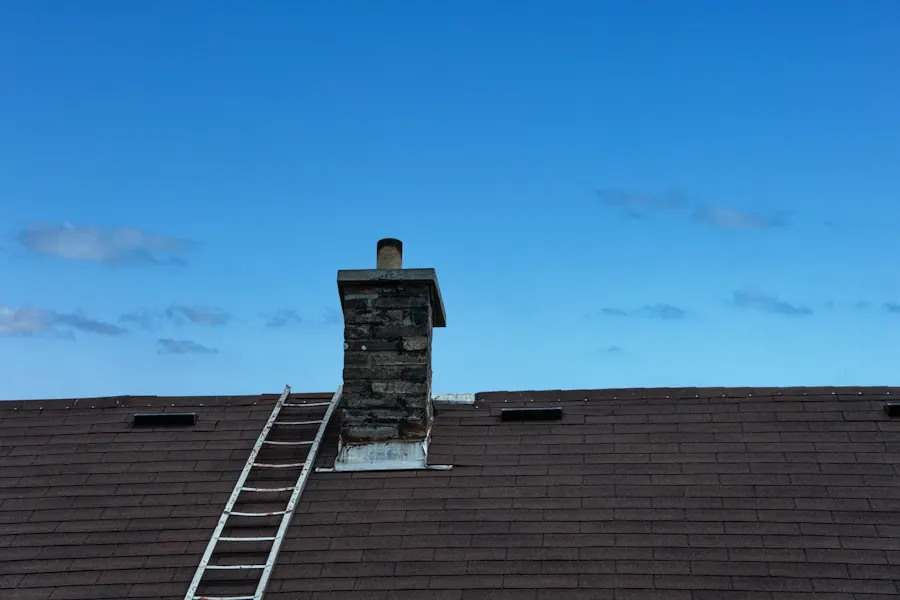
The anatomy of a chimney, top to bottom
Six parts, each with its own way of failing. When you call, naming the part gets the diagnosis halfway there.
- Crown
- The sloped concrete lid across the top of the stack. When it cracks, it stops shedding water and starts funneling it into the masonry below — the single most common start of chimney trouble in Fayette County.
- Cap
- The metal hood over the flue opening. Keeps out rain, birds, and squirrels. Cheap to replace, expensive to ignore: an open flue swallows gallons in every storm. Which lid is which — cap, chase cover or crown — is a page of its own.
- Flue & liner
- The passage the smoke and gases actually travel. Clay tiles crack with age and heat; older homes may have no liner at all. This is its own subject — and the highest-stakes one.
- Masonry
- The brick and mortar everyone can see. Mortar joints are designed to fail before the brick does — repointing them on schedule is what keeps the brick itself out of trouble.
- Flashing
- The metal weave where chimney meets roof. A failed flashing leak shows up as a ceiling stain near the fireplace and gets blamed on everything else first. The two layers and how the metal is re-let into the joint — step flashing, counter flashing and the reglet — are a page of their own.
- Firebox & damper
- Where the fire lives and the throat that controls it. Rusted dampers, gapped firebrick, and smoke-stained lintels all say something about the flue above.
Mortar matched to the house, not the bag
Lexington's housing stock spans a century and a half, and mortar chemistry changed along the way. Pre-war brick was laid in soft, lime-rich mortar that flexes with the wall; modern Portland mixes are far harder. Put a hard modern mortar on soft old brick and the joints win every freeze-thaw argument — the brick faces shear off instead. It's the classic repointing mistake, and it's why strength, sand color, and joint profile should be matched to what's already there, whether the chimney belongs to a shotgun house near downtown or a 1990s two-story in Hamburg. The same discipline applies out in Versailles horse country, where the brick is oldest and least forgiving.
- Diagnosis before quote. The water path should be found first. Repairing the symptom without closing the source is how the same chimney gets fixed twice.
- Grind, don't smear. Failed joints should come out to sound depth before new mortar goes in. Slower, and the only way it lasts.
- Cure protection. Fresh work should be covered and, in shoulder season, scheduled around frost so it cures at full strength.
- Photos throughout. Ask to see the before, the during and the after; most owners never set foot on their own roof, and shouldn't have to take anyone's word for it.
How a tuckpointing job is done, joint by joint, from the grinding depth to the mortar match, has its own page. Not sure whether you're looking at a repointing job or a rebuild? That's exactly what a Level 2 inspection answers, with a camera and in writing. If the flue itself is the problem, the fix usually runs through a stainless liner rather than more masonry. The price band for a stainless reline, and what places one flue inside it, is broken out apart from the masonry. And once the masonry is sound, a breathable water repellent, never a sealer, is what keeps it that way.
Chimney repair questions, answered
How much does tuckpointing cost in Lexington?
Can spalled bricks be saved?
Repair or rebuild — where's the line?
When should I book masonry work?
Ask for one visit, a written scope and a firm number.
Chimney masonry across Lexington, Georgetown, Nicholasville, Versailles, Winchester & Richmond.
Call (859) 493-8726