Chimney Leak Repair in Lexington, KY
Find Where the Water Gets In First
Limestone Chimney Co treats chimney leak repair in Lexington, KY as a diagnosis first: the stain on the ceiling is the symptom, and five different entry points can produce it. The water path should be worked from the top of the stack down and photographed before the fix gets a name and a figure.
A brown stain near the fireplace, and five ways it got there
The stain shows up on the ceiling by the fireplace, on an interior chimney wall, or in drywall a room away from the actual gap, and it gets blamed on the roof first. Five entry points account for nearly every chimney leak: the flashing, the crown, the mortar joints, the flue opening, and, on the old flues, water the chimney is making by itself.
Flashing: the metal weave where the chimney meets the roof
The layered metal seal where the stack rises through the roof lifts or corrodes, and rain follows the brick down into the framing and drywall. Its variables live under the shingles: the roofing material, and whether the counterflashing was ever properly let into the mortar joints. Flashing is priced after inspection for that reason; finding the entry point matters doubly here, because stains get pinned on flashing when the true source is a cracked crown higher up. How step and counter flashing are let back into the joint, and why a tar patch fails, is the flashing repair itself.
A cracked crown, or joints gone to sand
The crown is the chimney's own roof, a sloped concrete lid across the top of the stack; cracked, it pours water straight into the brickwork it was built to protect, the most common start of chimney trouble in Fayette County. Below it, joints gone sandy let water into the wall on every rain, and each freeze turns the wetting into a wedge. White streaks down the brick are the early warning that one of these two is open. Repointing the sandy joints runs $500–$2,500 here; a crown is resurfaced or poured new, priced from the roof.
No cap on the flue, and every storm pours straight down
The simplest leak is the flue opening itself: no cap, or a rusted-out galvanized one, and the passage the smoke travels swallows gallons in every storm. That water lands in the firebox, rusts the damper, and shows up as damp on the hearth rather than a ceiling stain. A stainless cap fitted to the flue is usually the least expensive item on any scope, quoted on the roof. Which lid is failing — cap, crown or a chase cover — has its own page.
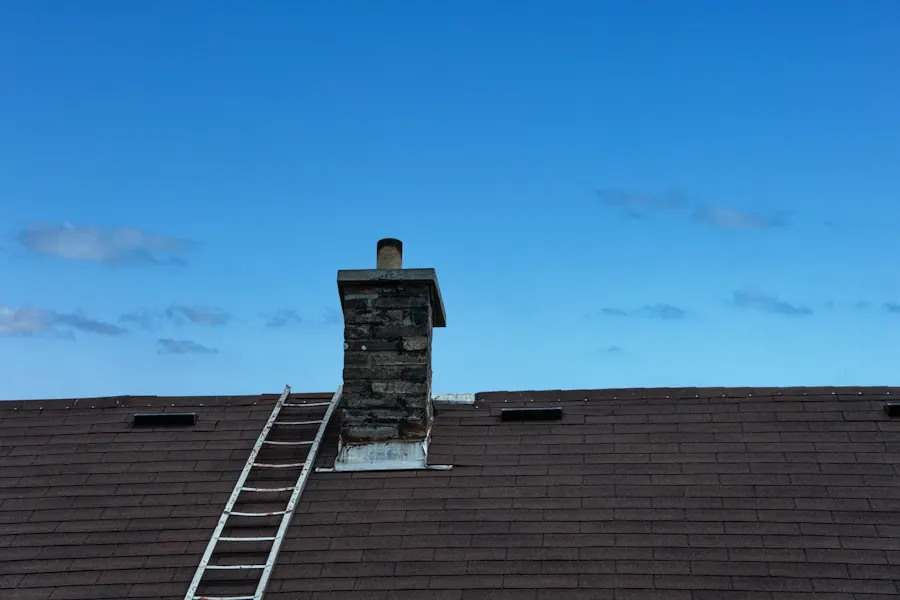
The leak that isn't rain: condensation in a coal-era flue
Some chimneys make their own water. A gas furnace or water heater piped into a big, often unlined flue built for coal sends up exhaust that is cool and wet; it condenses inside the stack as mildly acidic moisture. From the room it mimics a leak convincingly — damp patches on an interior chimney wall, a white crust on the brick up top, rusty streaks at the cleanout — and no roof work stops it, because the water comes from below. The fix is a stainless liner matched to the appliance, $1,500–$7,000 in this market and a common install in Winchester's coal-era housing.
Top down, with a photograph of the entry point
The water path should be worked from the top: crown, cap, joints, flashing, then the flue interior, with a camera where the flue is in question. Ask to see the actual source in photos, and a fix aimed at that source rather than a tube of caulk and an invoice. Masonry fixes wait for the March-to-November season; a leak found in January can still be scoped and priced while it waits.
What callers ask when the ceiling is stained
Who fixes a chimney leak, a roofer or a chimney company?
How much does chimney leak repair cost in Lexington?
Can I seal the chimney to stop the leak?
Photograph the entry point. Then name the fix.
Call (859) 493-8726, Mon–Fri 8:00am–5:30pm, or book the roof visit — the source in photos, the fix in writing.